
 Springtime ... the daffodils and forsythia are blooming, so it must be time to process some fleece.
Time to make a beauty out of the beast. Start with a cold-water bath for about a week -- just a fleece and rainwater. You just leave it alone -- no playing with the fleece unless you want to tempt the felting gods. After a week, the sheep dip becomes pretty aromatic; however, the results are worth it. The fleece rinses off nice and clean, with very little Eau de Barnyard.
 Next, dry the fleece using your method of choice. Mine is to drape it over some tree branches in the back yard. The neighbors are not amused but not worked up enough to ask me what in the world I'm doing. It works out well, because I'm not amused when they burn sticks, leaves, and whatever else they've got in a barrel in their back yard. Last I checked, we're smack in the middle of suburbia here, not out in the sticks. But I digress...


 So now I have a bucket (a couple, actually) of dry chunks of mystery fleece. It's time to turn those chunks into puffballs.
First, I grab a handful of fibers and pull them apart, grabbing one bunch of ends in one hand and the other bunch of ends in the other hand. You can see that the ends are starting to fluff out in that third picture. I do the pull-apart one more time, and now I have a lovely handful of fiber ready for the drum carder.


 Next, I turn the carder's handle and let the big drum pull small bits of wool from my hand. Putting the prefluffed wool directly on the large drum is much easier or both me and the carder than trying to feed it through the licker-in (smaller wheel). So, once the large drum appears full, I insert the doffer at the seam where the ends of the carding cloth meet. Once I've levered the doffer up and through the wool (second picture), I switch to a small knitting needle and gently doff the wool from the teeth every couple inches or so. The fourth picture shows that the wool from this round of carding is only about halfway aligned.


 Now I feed small bunches of the wool into the carder via the licker-in. You can see the detritus in that smaller drum. Periodically I'll use the knitting needle to clean out between the teeth, using the fibers as a mulch for my potted herbs.
OK, so after feeding in a reasonable amount of fiber (meaning that I can still see the teeth), I doff that bit and call it good. Sometimes I'll run the wool through a third time, depending on how much stuff is in it. Now the wool is all clean and aligned. Nice!


 To make the wool "bumps," I tear the roving in half lengthwise and put half aside. I wrap the other half loosely around my hand, then pull the end into the middle of the bump. Viola!
 So there it is -- again: beast to beauty. (It looks like this might become an annual post.) I just love the miracle that happens between shearing and spinning.


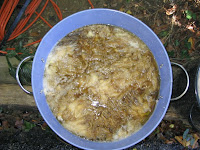 And another soaking ...
 And a couple more soakings, each in hot water and dish soap, each just begging to be swished and sloshed around that bucket. Be warned, though, that if you harrass the fleece, you'll end up with a lump of felt.
 In our next exciting episode, we'll take a look at carding the wool and, if I have the time and energy to fight with Blogger, spinning.